
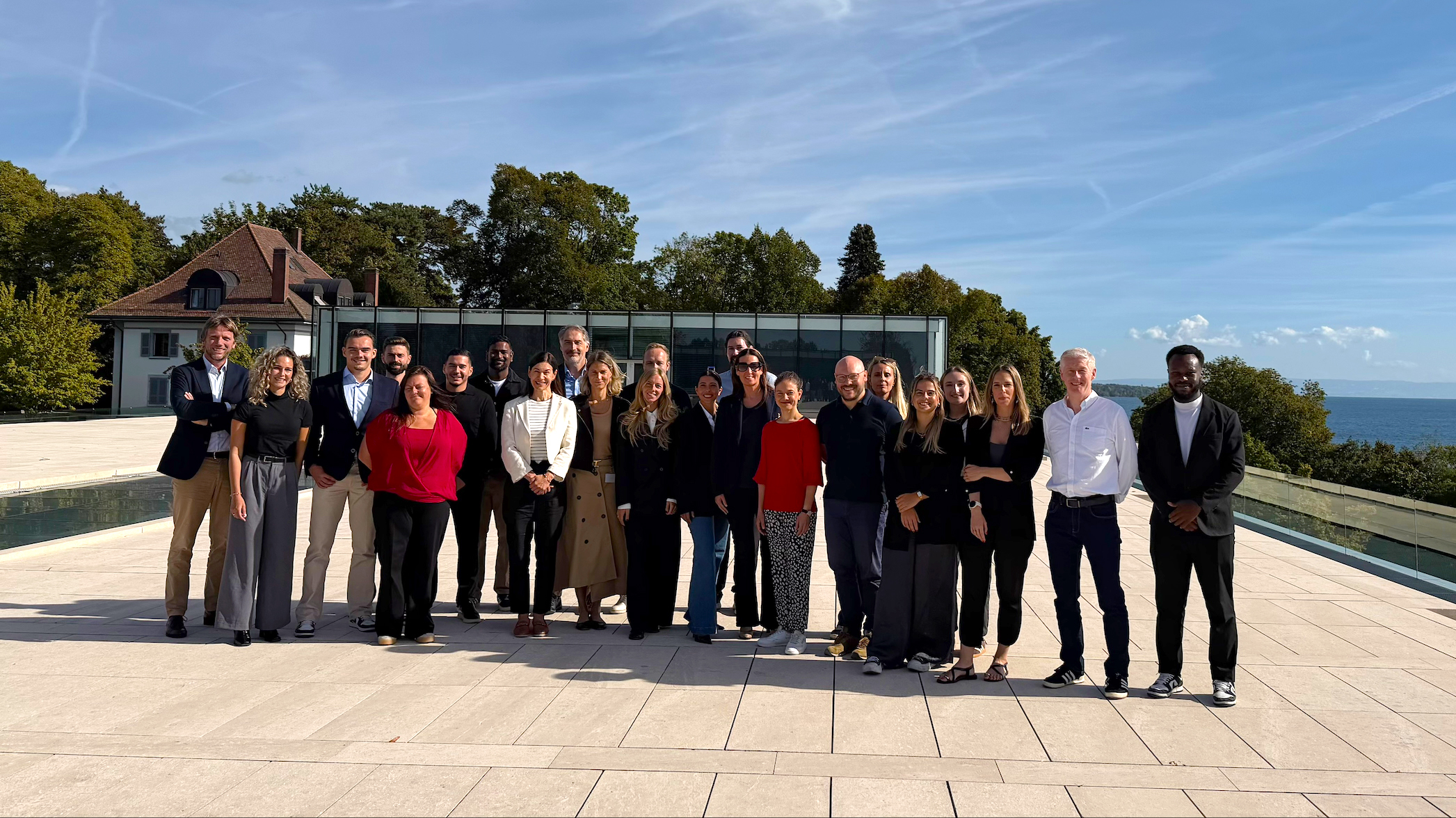
European Leagues and UEFA jointly hosted a two-day workshop in Nyon on 16 and 17 September, with a focus on advancing sustainability across domestic professional football.
The meeting brought together 19 sustainability experts from professional domestic leagues across Europe, alongside sustainability experts from UEFA and European Football Clubs (EFC). The gathering allowed participants to exchange perspectives and good practices, explore ways to advance social and environmental sustainability within domestic competitions, and consider how best to strengthen cooperation across the European football ecosystem.
Over the two days, participants discussed how sustainability can be further embedded within the strategies and operations of leagues and their affiliated clubs. The exchanges covered social responsibility, environmental sustainability and accountability, with member leagues sharing details around projects, approaches and practical experiences from their respective domestic competitions.
The workshop provided leagues at different stages of their sustainability journeys with an opportunity to learn from one another and helped highlight how approaches can be adapted to the realities, resources and priorities of different football markets.
Alberto Colombo, General Secretary of European Leagues, said:
“Cooperation between all football stakeholders is essential to advancing sustainability across football. That is why bringing our member leagues together with UEFA and club representative for two days of constructive exchanges was so valuable. Leagues, clubs and national associations must work in coordination and move in the same direction to drive meaningful progress at domestic level.”
Leagues as accelerators of sustainability
As organisers of domestic competitions and the central link to hundreds of professional clubs, leagues occupy a strategic position within the football ecosystem.
Their regular engagement with clubs enables them to translate broader sustainability ambitions into coordinated action at domestic level. In this sense, the workshop helped underline the position and responsibility of leagues to develop common standards, share practical tools and support clubs in their efforts to integrate sustainability into their strategies and matchday operations.
Through this multiplier effect, domestic leagues can act as accelerators of sustainability, helping individual initiatives develop into coordinated approaches capable of generating impact across entire competitions and communities.
The workshop also reaffirmed the shared ambition of European Leagues, UEFA and clubs to position sustainability as a strategic investment. Continued collaboration between all stakeholders will be essential to turn this ambition into practical and measurable progress throughout European football.
Filippo Veglio, UEFA Chief of Social & Environmental Sustainability, said:
“Sustainability in football will only progress through collaboration across the entire ecosystem. Bringing leagues together to exchange practical experiences helps accelerate learning and turn ambition into concrete action. Initiatives such as the Football Event Sustainability Manual demonstrate how collective efforts can provide practical tools to drive measurable progress. UEFA is committed to supporting this work and to collaborating with leagues, clubs and national associations to advance sustainability across European football.”
From guidance to action: Udinese applies the Football Event Sustainability Manual
The workshop took place only a few months after European Leagues and UEFA jointly launched the first-ever Football Event Sustainability Manual.
Developed as part of the work of the European Leagues Sustainability Expert Group, the manual provides leagues, clubs and national associations with practical guidance for embedding environmental, social and governance considerations throughout every stage of football event organisation – from initial planning and matchday operations to post-event evaluation.
Later that week, the guidance was put into practice by a club for the first time since the manual’s launch. During its Serie A fixture against Cagliari over the weekend of 19–20 September, Udinese Calcio implemented its new “Play for Sustainability – Our Planet, Our Game” initiative.
Using the manual as its framework, Udinese implemented and assessed measures covering energy, waste management, responsible catering, accessibility and sustainable mobility. The initiative demonstrated how European guidance can be translated into practical and measurable action at club level, showcasing an approach that can be replicated across European football.
Magda Pozzo of Udinese Calcio said:
“Over the past six years, sustainability has become a defining pillar of Udinese Calcio’s identity and long-term vision. What began as a commitment to operate more responsibly has evolved into a comprehensive strategy that guides our decisions across environmental, social and governance areas.
Innovation has always been part of Udinese’s DNA, and we believe that football clubs have both the opportunity and the responsibility to lead by example. Our journey has shown that sustainability is not only compatible with sporting ambition, but can also be a powerful driver of long-term value creation for clubs, supporters and local communities.
Today, Udinese is recognised as a reference point in Europe for its commitment to sustainable development and its willingness to explore new approaches that can help shape the future of football. For this reason, we are especially proud to be the first club to implement the UEFA & European Leagues’ Event Sustainability Manual.
We hope that our experience can inspire other clubs across Europe and contribute to raising standards throughout the game.”
Reflecting on the initiative, Alberto Colombo added:
“Udinese’s implementation of the Football Event Sustainability Manual is an excellent example of this cooperation being translated into concrete action. This initiative provides a strong model for others, and we encourage leagues and clubs across Europe to follow this path and develop similar projects to increase collective impact.”
Back to All News