
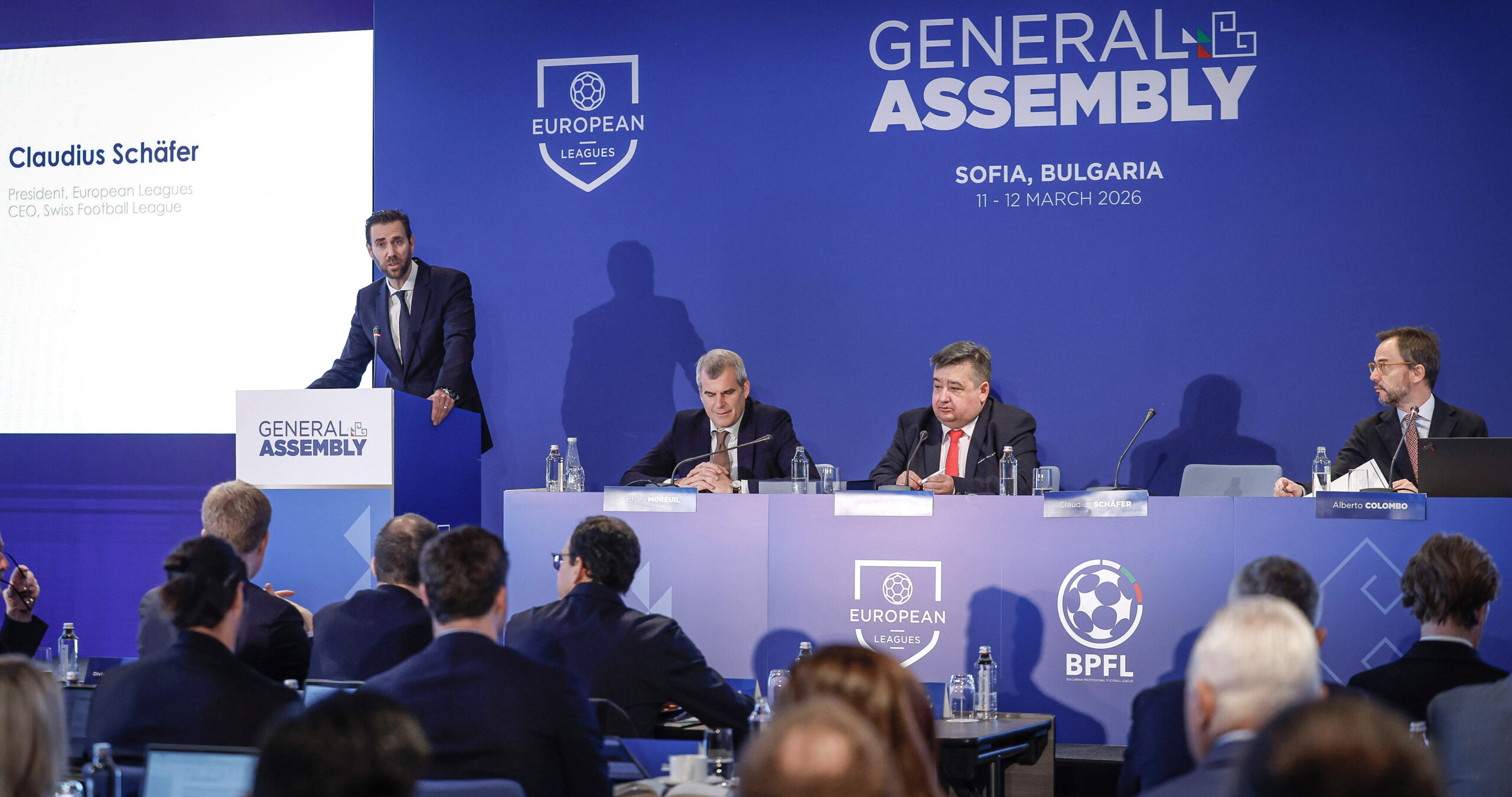
Dear colleagues, distinguished guests, and friends of European football,
It is a great honour to address you today at our General Assembly here in Sofia.
First of all, I would like to thank from the bottom of my heart the President of the Bulgarian Professional Football League, Atanas Karaivanov for his kind hospitality. Dear Atanas, we are deeply grateful to you for welcoming us with such warmth and generosity. Organising a gathering of this scale is no small undertaking, and we truly appreciate the care and effort that has gone into making this possible.
Sofia has always been a crossroads. For thousands of years, this remarkable city has stood at the intersection of East and West, shaped by the Thracians, the Romans, the Byzantines, the Ottomans — each leaving their mark, each adding a layer to a rich and complex identity. And yet, through all of that, Sofia endured. It found strength not despite its diversity, but because of it.
In many ways, this is also the story of European Leagues. We are an organisation of remarkable diversity — different histories, different cultures, different traditions, different models. A league from Scandinavia and a league from the Balkans do not look the same. They do not face the same challenges. But they share the same fundamental values: fair and open competition, financial fairness, and the belief that football belongs to everyone — not just to the few.
So it feels entirely fitting that we gather here today, in this city of crossroads, to reaffirm our unity and to speak with one voice on the future of our game.
I would like to welcome the guests of the stakeholders.
Allow me to begin with a brief reflection on my first year as President of the European Leagues — a first season in which we have been working to do things differently.
Together with the Board of Directors, we have made a deliberate effort to be more inclusive and more attentive to the needs of our members. We have improved the flow of communication between myself as President, the member leagues represented on the Board, the Administration, and all Member Leagues across Europe. Our goal has been simple: to reduce the distance — to make European Leagues feel not like a distant institution, but like a shared home.
I want to take a moment to acknowledge the strength of our Board of Directors. In particular, I wish to recognise our Vice-President Mathieu, whose deep expertise on European Union matters, strong EU relationships, and extensive network are absolutely fundamental to our current agenda. His contribution is invaluable.
I also want to acknowledge the work of our General Secretary and the Administration, who support us every day with dedication and professionalism. Dear Alberto, it was the best decision to appoint you as our new GS. Your commitment to the European Leagues is unique, and I really enjoy working with you.
The message I want to send to our members and to all stakeholders is this: our leadership is united. We work together, in the same direction, with the same commitment. We work as a team — and this makes us stronger.
We also want to work differently — and better — with our stakeholders. Over the years, European Leagues has sometimes been criticised for being an organisation focused on complaints; more reactive than proactive. That approach is now changing.
We are moving forward with our own ideas on how to develop the game and how to protect domestic league football — which represents the backbone of our entire industry and the foundation of the football pyramid. We will be proactive. We will be constructive. And we will come to the table not just with objections, but with solutions.
For the first time, we have developed a comprehensive strategic document with clearly defined objectives and a concrete action plan for the next two seasons — 2025/2026 and 2026/2027. This document was presented by our Administration to the Board and then discussed in November, and we are now in the midst of its implementation. Alberto will present the details of our Strategic Priorities later in today’s agenda.
Our members run domestic league competitions. The best league football in the world is played in Europe. And let us not forget: more than 90% of European professional clubs compete and develop solely at domestic level. The same is true of the overwhelming majority of professional players.
Our agenda is not disruptive. What we want is straightforward: we want our leagues and their clubs — all clubs, not just the elite few — to develop, to grow, and to be run in a sustainable financial manner.
To achieve this, our member leagues invest enormous effort in developing complex regulatory frameworks at domestic level: redistribution of revenues, cost controls, expenditure rules. All of these have one ultimate purpose — to present to our fans and commercial partners a product that is appealing and competitive on the pitch.
The unpredictability of results on the pitch is the most important asset of any sporting competition. We tend to forget this. We must not. The protection of competitive balance is a cornerstone of our organisation and enshrined in our Statutes.
Why, then, do we look with concern at the evolution of international football? Let me be clear: we are not opposed to the development of international football. But the expansion of international football must not happen at the expense of domestic league football.
The trend is undeniable: the international football calendar is expanding — the UEFA Champions League calendar reform, the introduction and potential expansion of the Club World Cup, the expansion of the FIFA World Cup, and so on. This calendar expansion does not take place without consequences. It causes significant operational disruption for our leagues and clubs.
And it is accompanied by an international product that grows more powerful in the market each season. International football revenues are growing at a significantly faster pace than domestic league revenues. There is an ongoing process of cannibalisation of domestic league value — and we cannot ignore it.
Furthermore, the way international revenues are redistributed — with a disproportionate share flowing to the same handful of clubs who participate regularly in international competitions — is the primary driver of the worrying polarisation we are witnessing across the game. Financial polarisation. Player talent polorisation. Sporting polarisation. The gap between a few big clubs and the rest is, in certain markets, reaching levels that are becoming insurmountable.
This brings me to our central strategic objective for the years ahead: tackling the growing financial and sporting polarisation in the game by driving a significant change in the redistribution of revenues from international club competitions — while in parallel advocating for stronger cost-control and expenditure regulations across the board.
Before we can engage meaningfully on any of these specific issues, we must ask a more fundamental question: are the leagues at the table? Is the collective voice of domestic football being heard – and crucially does it carry weight that reflect the historical contribution that it has given to football? Is the governance architecture fit for purpose?
At global level, the answer is, frankly, crystal clear: No. And I say this not as a personal opinion — the European Court of Justice has ruled that FIFA must reform its governance and regulatory framework to ensure it is transparent, proportionate, objective and non-discriminatory, and to mitigate the fundamental conflict of interest that arises from being simultaneously the regulator of football and a competition organiser running competitions for its own commercial benefit and the benefit of a select group of top clubs.
When FIFA makes decisions about the international calendar or the expansion of its competitions, are leagues at the table? Are players at the table? They are not. FIFA retains the power to take unilateral decisions that affect the entire ecosystem, with little accountability for the consequences.
When it comes to UEFA, the situation is more nuanced. A stakeholder mechanism exists — at least we have a seat at the table. But we must ask ourselves honestly: are leagues properly represented? Is the balance of stakeholder representation adequate? Are the concerns of leagues regarding the calendar and revenue distribution genuinely taken into account?
I am confident that UEFA itself recognises these shortcomings. I believe they know there is significant room for improvement, and we remain confident that they will work on it. We will engage constructively — and we will hold them to account.
Colleagues, the challenges before us are significant. But so is our resolve. Domestic leagues are the lifeblood of football. They are where players are developed, where communities find their identity, and where the game — in all its passion and unpredictability — truly lives.
European Leagues will continue to fight for a football ecosystem that is fair, balanced and sustainable — for all leagues, for all clubs, and ultimately for all fans.
But colleagues, I want to leave you with a sense of urgency. We must be clear about one thing: it is now or never. Leagues are under enormous pressure, and the calendar expansion has now reached a tipping point. If we continue on this path, the polarisation we have already described will become unsurmountable in most countries. In some, it already has.
The risk that fans grow tired and disengaged is real. New generations consume football differently — and if we fail to protect the quality and integrity of our product, we risk undermining it for the medium and long term. This is not a distant threat. It is concrete and it is present.
I am making a wake-up call to the political leadership of all football stakeholders. Next week, I will meet President Ceferin — and I will be clear and firm: we need to act now. The upcoming negotiations on the revenue distribution of UEFA Club Competitions for the 2027–2031 cycle are a concrete and immediate opportunity. Let us not squander it. Let us think about the football we want for the next generations — not just the next competition cycle.
We need to keep the dreams alive — of millions of children and fans across Europe. The fans of 1,500 professional clubs, with thriving communities in every corner of our continent. Not just the fans of the top 30 clubs and global brands.
We meet in a city – Sofia – whose very name means wisdom — and wisdom is precisely what our game needs right now: the wisdom to protect what makes football great before it is lost. This is the responsibility we face as football leaders – to hand over a game to a future generation of players and fans that provides them with the joy and fulfilment the game has given us.
Thank you very much.
___________________________
President, European Leagues
Sofia, 12 March 2026
Back to All News